Technology · five-stage process

Aerobic digestion. At source.

Food waste in. Filtered liquid out — through the existing kitchen drain. Continuous, enzymatically dosed, fully automated.

  1. 01

    Input

    Scraps loaded continuously during service. Top-loading.

  2. 02

    Dosing

    Griffon 100 bioactive dosed automatically from the internal reservoir.

  3. 03

    Digestion

    Microbes on the biochip bed break down the mass aerobically, 24/7.

  4. 04

    Filtration

    Mesh stops particles above 0.8 mm. Liquid only passes.

  5. 05

    Discharge

    Filtered effluent exits to the existing drain.

What goes in

What you can feed Griffon.

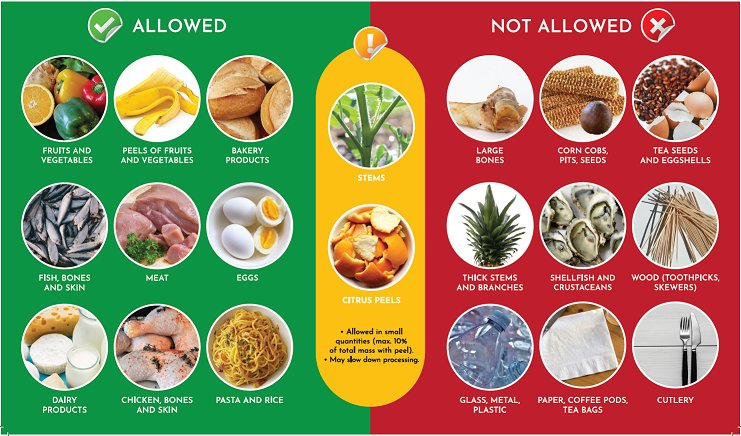
Griffon handles the food residues a professional kitchen actually produces — fruit and vegetables, peelings, bakery, meat, fish, eggs, dairy, and cooked pasta and rice. A few hard or non-organic items must be kept out to protect the mechanism.

Chart of food residues Griffon accepts and does not accept
Inside the chamber

The biochip bed
and the biology.

Two consumables drive the digestion. Biochips — the porous medium that fills the chamber and hosts the microbial colonies — and Griffon 100, the Bacillus spore and enzyme solution dosed automatically onto them.

Biochips · the living bed Porous, irregularly shaped carrier medium. Maximises colonised surface area and keeps the bed aerated and evenly moist. Remains in the chamber — not consumed, replaced roughly every 2 years.
Griffon 100 · composition Multi-strain Bacillus spore blend, 100% spore form for stability. Seven extracellular enzymes — protease, lipase, amylase, cellulase, urease, esterase, xylanase.
Operating range pH 5.0–10.0 · 5–50°C · 12-month shelf life in unopened container.
Prepared & packaged in Croatia Blended to a fixed specification, diluted to working strength, packaged and quality-controlled by Griffon Waste Management, and stocked across all seven operating markets — so every installation runs on identical, controlled input.
Safety & operation

Engineering
discipline.

24/7 continuous operation

No batch cycles. No emptying. No off-hours. The system runs continuously and is loaded whenever scraps are generated.

Stainless-steel construction

Full stainless body, inverter-driven motor, internal enzyme reservoir, sealed digestion chamber. Top-loading from the upper side.

Safety door interlock

Mechanical and electrical interlocks prevent operation with the chamber open. Compliant with EU machinery directive 2006/42/EC.

Digital touch interface

Status monitoring, scale data, alarms, and logging readouts available locally. CSRD-aligned exports for ESG reporting integration.

CE EU certified · all five models

Three directives.
Twelve EU standards.

Every Griffon digester complies with the EU Machinery Directive (2006/42/EC), Low Voltage Directive (2014/35/EU), and Electromagnetic Compatibility Directive (2014/30/EU). Twelve specific HRN EN ISO standards apply to construction, safety, electrical systems and food-contact hygiene. Full conformity declaration available below.

Independent validation

The most desirable
on-site treatment.

A 2022 research study by the University of Zagreb, Faculty of Geotechnical Engineering assessed the carbon footprint of food-waste management. After donation, it identifies on-site aerobic treatment (Griffon) as the most desirable option — with the lowest processing footprint of the devices tested.

Griffon 21.40 kg CO₂ eq. per tonne
Dehydrator + composting 346 kg — 16× higher
Landfill, no gas capture 2,965 kg — 138× higher
Process energy

No drying. No heating stage.
Very low energy.

Griffon runs on small single-phase motors with no high-power drying element. At maximum rated throughput that is about 0.03–0.06 kWh per kilogram of food residues (nameplate rating, a conservative upper bound) — consistent with the University of Zagreb figure of 21.40 kg CO₂/t. Any process that reduces mass by drying must instead supply the latent heat of vaporisation of water — roughly 0.45–0.55 kWh per kilogram of residues before losses. Because Griffon discharges water as liquid rather than evaporating it, that dominant energy term simply does not apply.

0.03–0.06
kWh per kg (Griffon)
0.18–1.5
kW installed, single-phase
0
heating / drying stage
Engineering principle

Two external connections.
Everything else automated.

Electricity and water in. Filtered liquid out through the standard drain. No three-phase power required — single-phase 220–230 V at 50/60 Hz. Installs anywhere a normal kitchen appliance can be plugged in.

Specify your model ROI